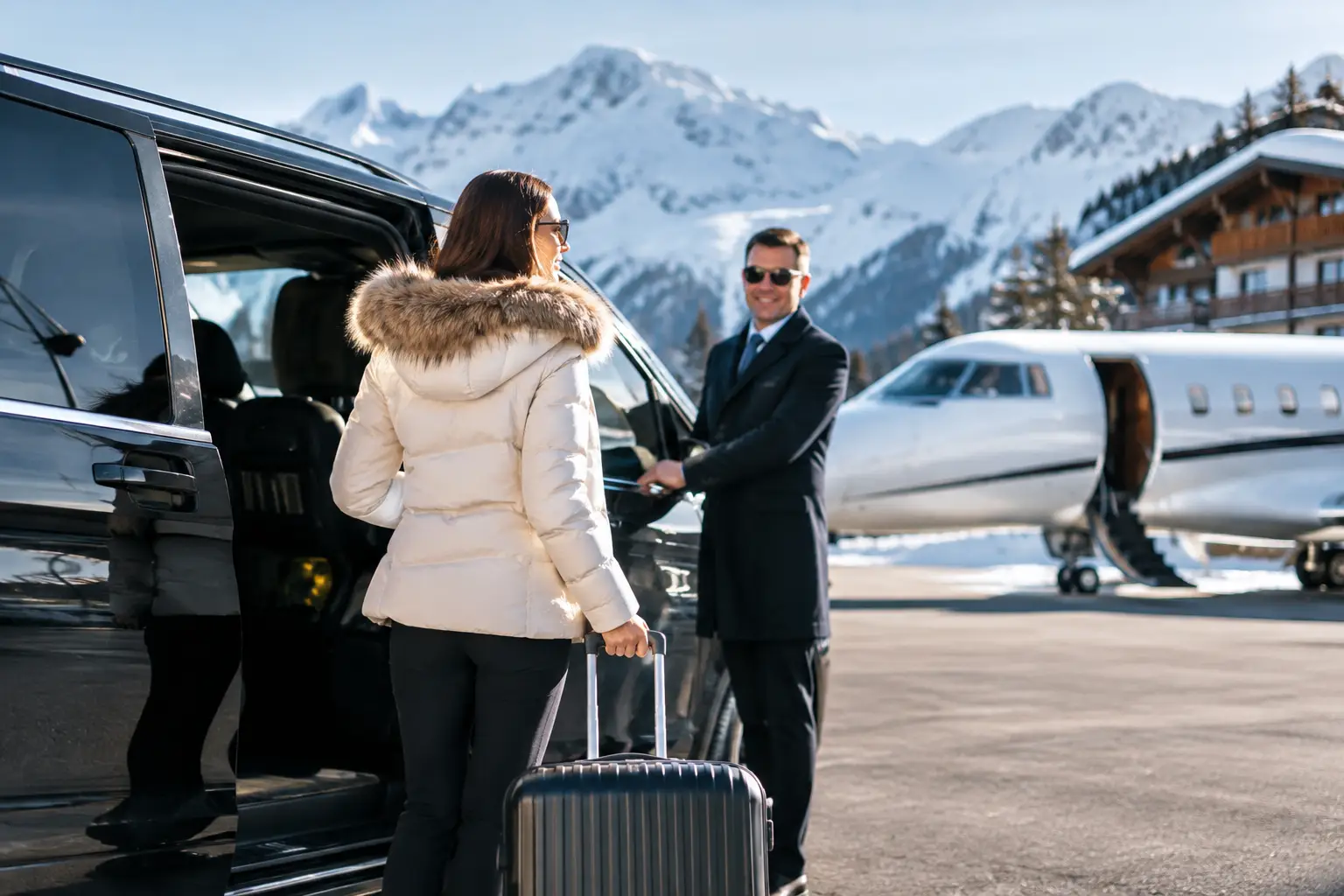
Ski Chalet Airport Transfers, Considered
The last stretch of an Alpine journey often sets the tone for the week ahead. After an overnight flight, a crowded arrivals hall and the prospect of snow-covered roads, ski chalet airport transfers are not merely a practical booking. They are the point at which a holiday becomes private again: luggage disappears into a well-appointed vehicle, children settle, and the landscape begins to take over.
For guests staying in a private chalet, the transfer deserves the same consideration as the residence itself. The right arrangement accounts for the airport, the resort, the composition of the party, ski equipment, weather, and the small preferences that make travel feel properly looked after rather than managed.
Why ski chalet airport transfers deserve advance planning
The Alps are close enough to major international airports to appear straightforward on a map, yet winter travel is shaped by variables that cannot be solved at the last minute. Saturday changeover traffic, active snowfall, chain requirements, road closures, and delayed flights can each alter a journey considerably. A transfer that is perfectly adequate for two travelers with soft luggage may be unsuitable for a multigenerational family arriving with ski bags, strollers, and several weeks’ worth of winter layers.
Planning early also gives you better choices. At peak periods, the most experienced chauffeurs and the most appropriate vehicles are committed well ahead of arrival day. This is especially true for festive weeks, February school holidays, and major resort events. The aim is not simply to reserve a car. It is to select a journey that suits the rhythm of the stay.
For a family heading to Courchevel 1850, this may mean an early flight into Geneva and a vehicle large enough for everyone to travel together. For a couple staying above Megève, it may mean a discreet sedan from Geneva or Lyon, timed to leave enough room for lunch before chalet check-in. A group bound for Zermatt needs a more layered arrangement, with road transfer to Täsch followed by the final car-free village connection.
Start with the airport, not the resort
Many celebrated ski destinations can be reached through more than one airport. The most convenient choice depends on the exact chalet location, flight schedules, traffic patterns, and whether the journey takes place on a weekend.
Geneva is a natural gateway for Chamonix, Megève, Verbier, Courchevel, Méribel, and parts of the French and Swiss Alps. Its range of international arrivals makes it particularly useful for groups traveling from different cities. However, its popularity also means busy roads on peak Saturdays, especially toward the Tarentaise Valley.
Chambéry, Lyon, Grenoble, and Turin can offer sensible alternatives for the French Alps, depending on flight availability and resort. Zurich is often favored for St. Moritz and certain Swiss destinations, while Milan Malpensa or Bergamo may be well suited to the Dolomites. Innsbruck provides an appealingly close arrival point for St. Anton, although its flight options are more limited than larger hubs.
The shortest driving time is not always the best choice. A slightly longer journey from an airport with a more reliable flight schedule, simpler baggage collection, or less congested departure routes can be the more comfortable decision. This is particularly relevant when traveling with young children or arriving after a transatlantic flight.
Allow for the realities of winter roads
Transfer times quoted in fair conditions should be treated as a useful baseline rather than a promise. Mountain weather can be local and changeable. A clear drive through the valley may become slow-moving higher up, where snow is falling and traffic is fitting chains.
An experienced Alpine chauffeur will travel in a properly equipped vehicle, understand the alternate routes where they exist, and adjust driving to conditions rather than a schedule on paper. Even so, some delays are simply part of winter in the mountains. Building an unhurried buffer into arrival and departure days is one of the most elegant forms of trip planning.
For departure, it is prudent to schedule collection earlier than instinct suggests. This is not about spending unnecessary hours at the airport. It is about avoiding the particular frustration of watching time disappear behind a snowplow or a queue at a valley roundabout.
Choose a vehicle for the whole party, not just the seats
A transfer vehicle should be selected according to luggage volume as much as passenger count. Ski holidays generate more equipment than city breaks: large suitcases, ski boots, helmets, outerwear, child seats, and sometimes personal skis or snowboards. Four adults can fit comfortably in an SUV while their luggage cannot.
For couples or small parties traveling light, a premium sedan or executive SUV can be an excellent choice. It offers privacy and a quieter journey, particularly on smoother routes from Geneva to Megève or Chamonix. For families and friendship groups, a long-wheelbase van or luxury people carrier generally provides more sensible space. The cabin remains comfortable, and no one begins the holiday with a bag at their feet.
If your party is large, two coordinated vehicles may be preferable to one oversized option. This can make mountain roads easier to navigate and preserve personal space after a long flight. It also provides useful resilience if a flight is delayed or members of the group arrive separately.
When confirming the vehicle, be precise about what you are bringing. Mention ski bags, board bags, infant seats, oversized luggage, pets, and any mobility requirements. These details are simple to share in advance and difficult to improvise at an airport curb.
The arrival experience should feel calm, not ceremonial
Luxury is often most convincing when it is barely noticed. A well-handled transfer does not need theatrical gestures. It needs a chauffeur who is waiting in the right place, has monitored the flight, understands the destination, and knows when to offer conversation and when to allow quiet.
For guests arriving from long-haul flights, thoughtful provisions can make a marked difference: chilled water, a light snack, Wi-Fi where reliable, and appropriate child seating already installed. In winter, a warm vehicle and clear luggage handling are more meaningful than unnecessary formality.
There is also value in ensuring the driver has the chalet’s precise access instructions. Alpine addresses can be deceptive, particularly in snow or after dark. A residence may sit on a private lane, above the village center, or at the end of a steep approach where local knowledge matters. The final ten minutes should not involve phone calls, pin drops, or uncertainty about where to unload.
Transfers for car-free and ski-in locations
Some of the most appealing mountain stays require a little more coordination. Zermatt, for example, is car-free, so the transfer naturally involves a handover at Täsch and onward travel by electric taxi or train. The process is straightforward when arranged correctly, but it needs to reflect the amount of luggage, the arrival time, and the location of the chalet within the village.
Certain ski-in, ski-out residences have limited winter vehicle access, especially during heavy snowfall. In these cases, luggage may be delivered separately, or guests may complete the final section by snow vehicle, resort shuttle, or a short walk. This is not a compromise when properly planned. It can be part of the character of an exceptional mountain setting. What matters is that guests know what to expect before they land.
Consider the return journey as carefully as arrival
The departure transfer is easy to overlook amid the pleasures of a chalet stay, yet it is the moment most likely to become hurried. Confirm the collection time at least a day before departure, particularly after heavy snow or during a holiday week. Check which terminal and airline are involved, and allow for ski equipment returns if rentals need to be dropped off en route.
For early flights, a light breakfast or coffee arranged before departure can be a considerate detail. For later journeys, there may be time for a final ski morning, but only if the logistics are genuinely comfortable. A rushed last run is rarely worth a tense drive down the mountain.
A more considered beginning to the mountains
The best ski chalet airport transfers do not call attention to themselves. They create a quiet passage between airport and chalet, leaving travelers free to notice the first snow on the pines, the changing light on the peaks, and the welcome waiting at the door. At Alpin Privé, this kind of preparation is part of the larger purpose of a private Alpine stay: making space for the mountain, and removing the distractions that stand in its way.
When planning your next winter escape, share the full shape of your journey early - flight numbers, party details, luggage, children, and onward plans. A few considered details at the beginning can preserve the calm of the entire week.
Comments