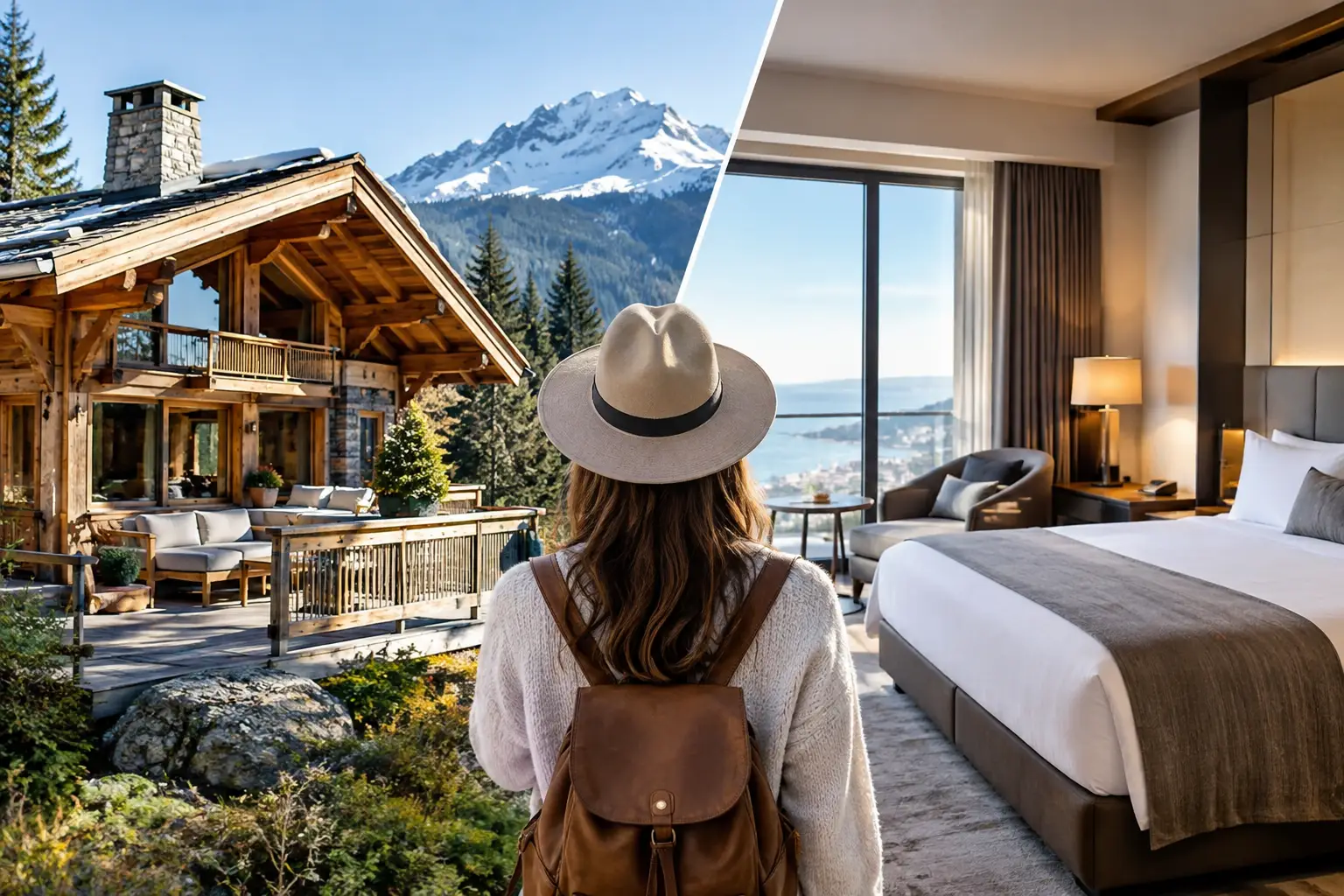
Private Chalet Versus Hotel: Which Fits?
The choice often becomes clear at the end of a ski day. One group returns to a lively hotel lobby, where cocktails, dinner reservations, and other guests set the rhythm. Another comes home to the silence of snowfall beyond the windows, boots warming in the ski room, and a fire already lit. In the private chalet versus hotel decision, neither is inherently better. The right setting depends on how you want the mountains to feel.
For some travelers, a grand hotel is part of the destination - sociable, polished, and effortlessly connected to the pulse of a resort. For others, especially families and groups traveling together, a private residence creates the more natural form of luxury: space to settle into, time that belongs to no one else, and service shaped around the household rather than a hotel schedule.
Private Chalet Versus Hotel: The Essential Difference
A luxury hotel offers a shared world. Its appeal lies in being looked after within an established setting: reception at hand, a bar with atmosphere, a spa downstairs, and a dining room that requires little thought. For a short stay, a couple’s escape, or travelers who enjoy the energy of a well-run property, that ease can be exactly right.
A private chalet offers a world of your own. The residence becomes the setting for the trip, whether that means a contemporary home above Méribel, a traditional timber chalet in the Engadin, or a discreet mountain retreat outside Zermatt. The living room is not a place to pass through between plans. It is where children play after skiing, friends linger over a late lunch, and a family gathers before dinner without considering anyone else’s timetable.
This distinction matters most on longer stays. Hotels are designed for circulation and convenience. A well-chosen chalet is designed for living, with rooms that invite different parts of a group to be together or separate as they please.
The Luxury of Space, Privacy, and Pace
Privacy is often discussed as a feature, but in the Alps it changes the entire experience. A private chalet removes the small frictions that can accumulate during a busy holiday: coordinating breakfast in a public room, finding a quiet corner after skiing, or gathering a group before leaving for dinner.
For multigenerational families, this can be transformative. Grandparents can read by the fire while younger guests use the cinema room or pool. Parents can put children to bed and continue the evening downstairs, rather than retreating to separate hotel rooms. A group of friends can spend an unhurried afternoon at home without feeling they should vacate a table or return to the bustle of the village.
That privacy does not need to mean isolation. The most appealing chalets place guests close to the resort while preserving a sense of retreat. Ski-in, ski-out access may allow a family to avoid morning transfers altogether. Elsewhere, a private driver can make the distance from home to lift, restaurant, or village center feel inconsequential. The question is not simply how near a property is to the piste. It is how smoothly the day unfolds once everyone is dressed, equipped, and ready to go.
Hotels retain an advantage for travelers who want visible activity around them. A solo traveler may prefer the social ease of a hotel bar. Couples taking a long weekend may value walking from a spa treatment to dinner without ever stepping outdoors. Privacy is precious, but it is not every traveler’s first priority.
Service: Structured Hospitality or Personal Rhythm?
The best hotels excel at consistency. There is comfort in knowing that breakfast is ready, the spa is staffed, and someone can arrange a table or transport with a quick call. Their service is practiced, immediate, and centered on the rituals of hotel life.
Chalet service is more personal when it is thoughtfully organized. It can begin well before arrival: stocking the kitchen with preferred wines and children’s favorites, arranging ski fittings in the chalet, reserving a mountain restaurant at the right time, and planning drivers around the group’s actual habits. Once in residence, a private chef, host, housekeeping team, or concierge can create a rhythm that is attentive without becoming intrusive.
The distinction is subtle but meaningful. In a hotel, guests enter a service system designed to work beautifully for many people. In a chalet, the service should adapt to the particular group. Breakfast may be early for first-lift skiers and later for everyone else. Dinner can be an elegant meal at home one evening and a relaxed spread after a day in deep snow the next. A celebration can remain entirely private, without the formality of a private dining room or the sense of being on display.
Service levels do vary widely among private homes. Some are best suited to independent travelers who want a beautiful base and occasional support. Others are fully staffed, with the operational detail of a fine hotel but a far more private setting. This is where careful curation matters. The residence, staffing model, and concierge support should match the way a group actually travels, rather than simply its headcount.
Dining and the Value of Having Your Own Table
Hotel restaurants can be a highlight of an Alpine stay, particularly in resorts known for exceptional dining. They also offer welcome spontaneity: dress for dinner, take the elevator down, and let someone else decide what happens next.
Yet private dining changes the tempo in ways many guests do not anticipate. There is no reservation to protect, no concern about tired children, and no need to conclude an evening because another seating is approaching. A chef can prepare a formal dinner after a day on the slopes, but just as importantly, can serve a simple lunch when everyone returns sun-flushed and hungry.
The strongest chalet stays rarely mean eating in every night. They create choice. Guests can enjoy the theater of a celebrated restaurant in Courchevel or St. Moritz, then return to the quiet of their own sitting room. On another evening, the best table in the resort may be the one beside the hearth.
When a Hotel Is the Better Choice
A hotel can be the more satisfying option when the trip is brief, the group is small, or the focus is firmly on the resort’s social life. Travelers who want a central spa, multiple restaurants, and the easy chance of meeting friends or fellow guests may find a hotel’s shared atmosphere appealing rather than distracting.
It can also make sense where a hotel’s specific identity is central to the journey. Some Alpine properties have a storied bar, a notable wellness program, or a location that places guests directly at the center of village life. For a two- or three-night stay, the convenience of arriving with little planning can outweigh the advantages of a larger private home.
The trade-off is that even an exceptional suite remains part of a public environment. There are schedules, shared spaces, and a degree of formality built into the experience. For travelers accustomed to having room to spread out, this can feel limiting after several days.
Choosing the Right Alpine Base
The most useful starting point is not accommodation type, but the shape of the trip. Consider who is traveling, how many nights you will stay, and what privacy means to your group. A couple seeking a lively long weekend may choose differently from three families sharing a week in Verbier. A group celebrating a milestone may need a dining space, a staffed kitchen, and enough bedrooms for everyone to feel equally well placed.
Also look beyond photographs. Ask how ski days begin, whether the chalet has genuine ski access or requires a short drive, what level of staffing is included, and how evening plans will work. In peak weeks, the quality of logistics is often as valuable as the beauty of the address.
At Alpin Privé, the most successful stays tend to be those where the home and the itinerary have been considered together. A secluded chalet may be perfect for a family that values stillness, while a residence near the center suits a group drawn to the restaurants and energy of the village. Both can be deeply luxurious when the choice is intentional.
Choose the setting that gives your group more of what it came to the Alps for: time together, access to the mountains, and the rare pleasure of not having to compromise the day around anyone else.
Comments