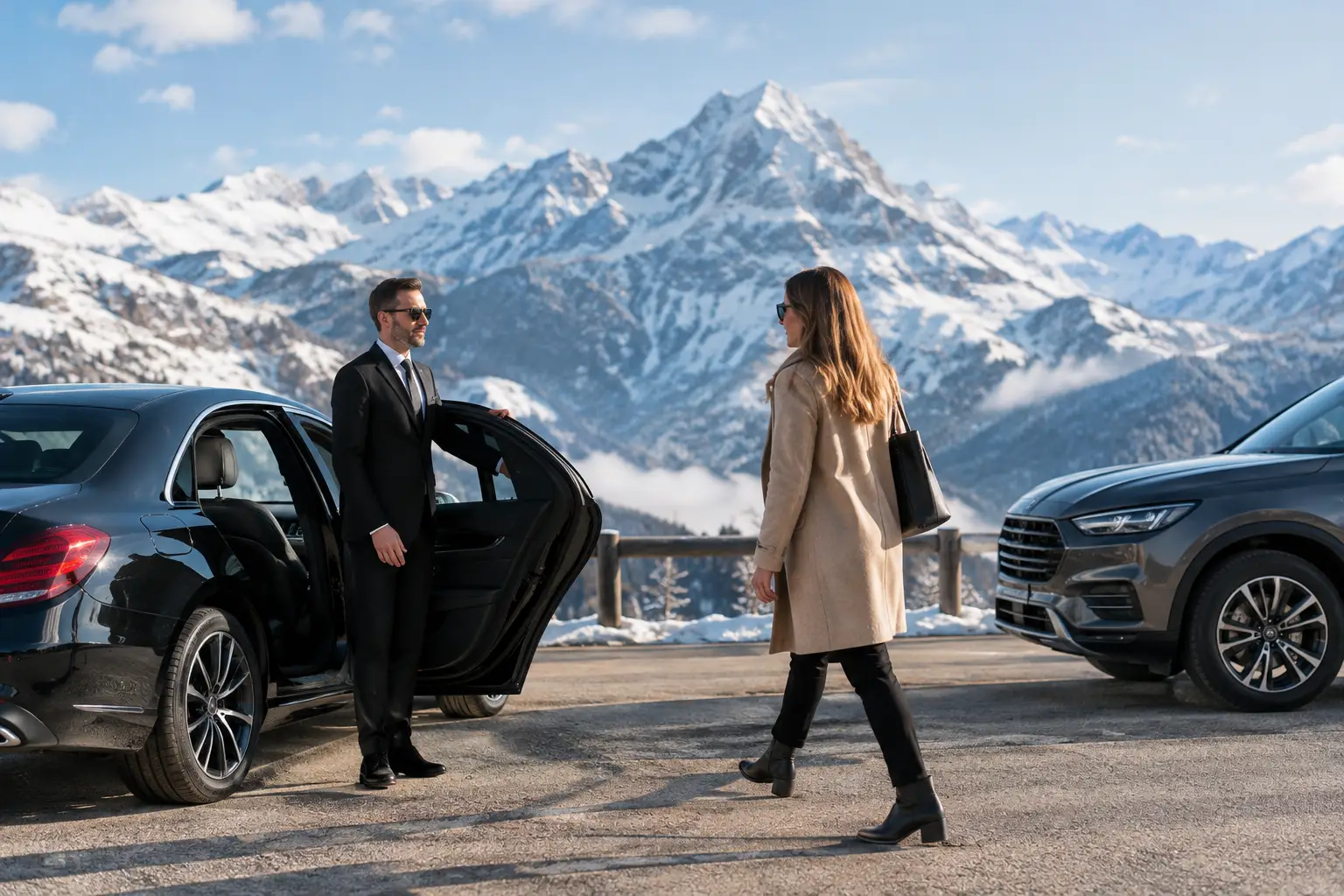
Chauffeur Transfer Versus Rental Car in the Alps
A winter arrival can set the tone for the entire week. After an overnight flight, a connection through Geneva, Zurich, or Milan, and the gradual climb toward the snow line, the practical question is not simply how to reach the chalet. It is whether a chauffeur transfer versus rental car will better suit the pace, privacy, and plans of your stay.
For some guests, driving is part of the pleasure: an early morning departure for a neighboring valley, an unscheduled lunch in a small village, or the freedom to explore beyond the resort. For others, particularly families and groups arriving with ski equipment, the luxury lies in stepping into a warm vehicle and letting someone else manage mountain roads, weather, parking, and timing. Neither choice is universally better. The right one depends on where you are staying, who is traveling, and how you prefer to spend your time once the mountains come into view.
Chauffeur Transfer Versus Rental Car: The Real Difference
The distinction is less about transport than mental space. A private chauffeur transfer removes a chain of small but consequential decisions: locating the rental desk, understanding winter coverage, checking the vehicle, fitting luggage, installing car seats, purchasing toll passes, and driving unfamiliar roads after a long journey. In the Alps, those details can be especially pronounced during a snowfall or on a busy Saturday changeover day.
A good chauffeur is also a local professional, accustomed to the approach roads, weather patterns, and the particular access requirements of mountain residences. At a discreet chalet above Méribel or on the quieter edges of Verbier, that knowledge matters. The driver can time the journey around congestion, coordinate with the property team, and ensure luggage arrives without turning an arrival into an exercise in logistics.
A rental car, by contrast, gives the itinerary a more independent shape. It makes sense for guests who want to move frequently between villages, prefer to dine widely beyond the resort, or are building a broader journey through the Alps. A family spending a week in a chalet near Megève may enjoy having a car for market visits, museum afternoons, and lunches in the surrounding countryside. In summer, when road conditions are simpler and mountain passes are open, the argument for a rental car becomes stronger still.
The question is not whether independence is valuable. It is whether you will genuinely use it enough to justify the responsibility that accompanies it.
Arrival Day Is Where the Difference Is Felt Most
Airport-to-resort journeys are often longer than guests expect. Geneva to Chamonix may be straightforward in clear conditions, while the same airport can involve a more substantial transfer for Courchevel, Méribel, Verbier, or Zermatt. Flight delays, weekend traffic, roadworks, and heavy snow can all alter the equation.
With a chauffeur transfer, the vehicle, route, and collection point are arranged before departure. A driver tracks the flight, waits through reasonable delays, and has the appropriate space for travelers and luggage. For a group of eight with ski bags, children, and several large cases, this is not a small consideration. The vehicle needs to be selected for the actual load, not merely the number of seats.
With a rental car, there is a satisfying sense of self-sufficiency, but arrival day can become more layered. Large SUVs and vans may be limited at peak dates, automatic transmission can carry a premium in Europe, and not every vehicle has the winter tires, snow chains, or luggage capacity that the booking description appears to suggest. If you are arriving late, tired, or with young children, those details deserve honest weight.
For couples traveling light to a resort with easy access and strong local transport, a rental car may still be perfectly comfortable. For multi-generational groups, private transfers generally make the first and last days of a holiday feel noticeably calmer.
Winter Driving Is Not Just About Confidence
Many experienced drivers are entirely comfortable on snow. Yet Alpine driving is different from navigating a familiar winter at home. Roads can be narrow, steep, shaded by forest, and subject to sudden changes in visibility. Chain controls are common during active snowfall, while underground parking and tight chalet access roads can present their own challenges.
The practical issue is not only whether you can drive in these conditions. It is whether you want to. A day on the slopes, followed by après-ski, dinner, and a late return along icy mountain roads, can feel less appealing when someone in the group must remain responsible for the car.
This is where a chauffeur arrangement offers a particular kind of ease. It allows everyone to enjoy an evening without designating a driver, and it can be organized as a one-way airport transfer, a return transfer, or dedicated in-resort transport for selected days. The middle ground is often the most thoughtful option: use chauffeured transport for arrivals, departures, and evenings, while relying on walking, ski lifts, or resort shuttles during the day.
Consider the Resort Before Choosing
Not every Alpine destination rewards a rental car equally. In Zermatt, for example, the village is largely car-free, so a conventional rental car is not a useful answer for the final approach. Chauffeured rail coordination and electric local transport are often more appropriate. In ski-in, ski-out settings, a car can remain parked for days without being missed.
Courchevel 1850, central Verbier, and many parts of Méribel offer enough restaurants, boutiques, lifts, and services within easy reach that guests may use a car less than anticipated. If your chalet includes a driver service or has simple access to local transport, the rental can become an expensive convenience with little practical purpose.
In contrast, a stay outside the central villages of Megève, Chamonix, St. Anton, or the Dolomites can invite more exploration. A car may give you access to distinct ski areas, secluded restaurants, galleries, and villages where the rhythm feels less curated. For summer stays, it also opens up trailheads and panoramic roads that are harder to reach by public transport.
Ask a precise question before booking: how many journeys outside the immediate resort will we realistically make? A car is worthwhile when it serves your actual plans, not the abstract idea of freedom.
Cost Is More Nuanced Than the Daily Rate
A rental car can look less expensive at first glance, particularly for a couple or small family. But the full cost includes insurance, fuel, tolls, parking, winter equipment, additional drivers, and sometimes a premium for a vehicle capable of carrying skis and luggage comfortably. In certain resorts, overnight parking alone is meaningful, especially during high season.
Private transfer pricing is clearer when it is arranged properly. For a group, the cost per person can be more reasonable than expected, particularly when the alternative requires two rental vehicles. It also avoids the risk of paying for a large SUV that spends the week beneath the chalet.
There is, however, no need to force chauffeur service into every itinerary. A rental car remains the sensible choice when guests are traveling over several regions, have a confident and willing driver, and value spontaneous daily movement. The most refined solution is not automatically the most expensive one. It is the one that feels proportionate to the trip.
A Practical Way to Decide
Begin with the residence. Is it within walking distance of lifts, restaurants, and village life? Does the stay include an in-resort driver, or can tailored transport be arranged for dinner reservations and key excursions? Then consider the group: children, grandparents, ski equipment, and multiple arrival times tend to favor chauffeured logistics.
Next, look at the rhythm you want. If the week is centered on the chalet, the slopes, long lunches, and evenings by the hearth, you may find little use for a rental car. If you are following a looser route through several valleys, dining in different villages, and using the mountain roads as part of the journey, a car provides welcome flexibility.
At Alpin Privé, transport planning is best considered alongside the residence and itinerary, rather than as a separate booking. The access road, the nearest lift, the group’s dining plans, and the character of the destination all shape the better choice.
The finest arrangement is often the one you barely notice: a calm arrival, exactly the mobility you need, and more time for the silence of snowfall, the warmth of the hearth, and the people you came to the mountains to be with.
Comments